Published in 2025
Deepflare achieves a manufacturable vaccine candidate with a more potent immune response on the very first try.
Our partner, Hawaii Biotech, took the notoriously difficult Zika Envelope protein and, with the Deepflare platform, designed mutations we predicted would boost its immunogenicity. It worked on the first try. Our design is bound to the neutralizing antibody, proving the B-cell epitope, the part crucial for a protective immune response, retained engagement (Fig. 1).
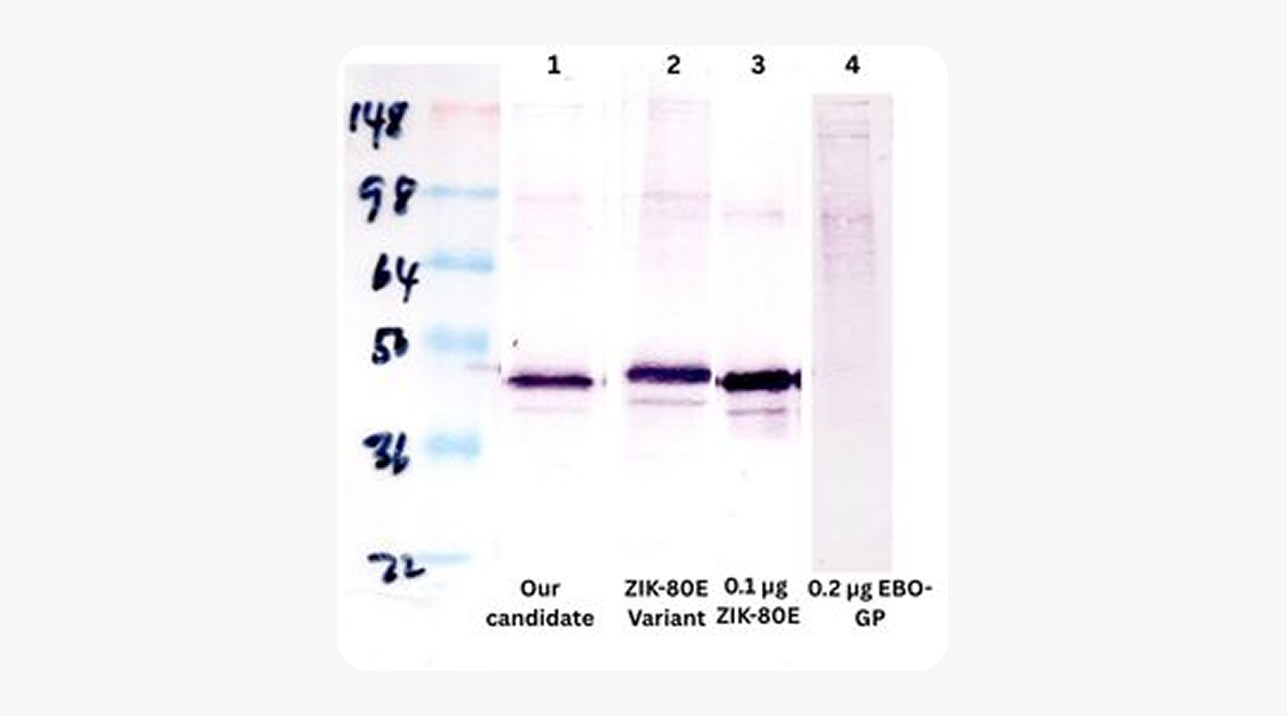
Fig 1. Proof of Expression: The Western Blot probed with Rabbit anti-ZIK-80E antibody. Our candidate (First lane) expresses at high levels, comparable to the two positive controls (Second lane - highly expressed variant expressed in the same conditions, third lane - 0.1 μg ZIK-80E). Despite heavy mutations,
As a negative control, we used the envelope glycoprotein of Ebola. Lanes 1 and 2 show two different constructs that were expressed and purified using the same method. Both variants yielded significantly higher expression levels than the standard Zika envelope sequence, confirming the success of our design.
Why This Is a High-Stakes Design Challenge
That mission required swapping out native residues for immunogenic T-helper epitopes to increase their immunogenicity. For any protein engineer, this immediately presents a multi-objective problem where a single gain can trigger a cascade of failures.
We were navigating three critical risks:
• Solubility Collapse: Many of the most potent T-helper epitopes consist of hydrophobic amino acids. Introducing them meant creating new, aggregation-prone patches on the protein surface. The primary risk wasn't just misfolding, but a catastrophic loss of solubility.
• Local Structural Disruption: Some of the mutations needed to occur in direct proximity to the conformational B-cell epitopes. A single substitution that alters a backbone angle or a side-chain interaction could completely ablate binding with a neutralizing antibody, rendering the entire design useless.
• Global Fold Instability: Beyond local effects, each mutation chips away at the protein's overall thermodynamic stability (ΔG). We were making numerous swaps, and the cumulative energetic cost could have easily destabilized the entire domain, indirectly destroying the B-cell epitope's architecture.
Therefore, our model wasn't just tasked with epitope grafting. It was balancing trade-offs: identifying residue swaps that were predicted to be highly immunogenic while simultaneously passing checks against aggregation risk, local structural integrity, and the preservation of global stability.
The structure after the redesign
Use our platform to visualise the differences in 3D!
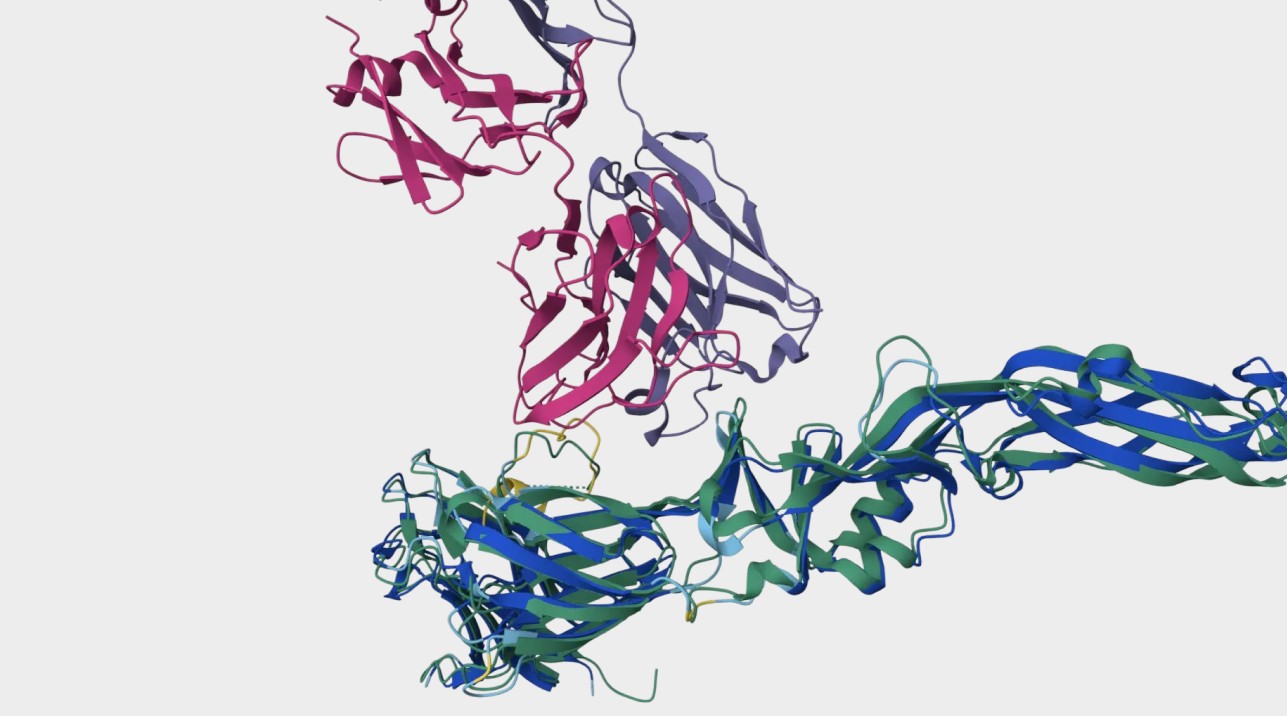
Fig 2. The Architecture Holds: A Perfect Fold. Our redesigned protein (blue) superimposed on the original crystal structure (green). The critical antibody binding sites are structurally extremely similar, explaining why it retained its function. Yellow colored regions are modified residues. Structural differences are visible, but they don’t impact the global fold and are not crucial for neutralizing antibodies.
You can clearly see that the binding of antibodies is not a fluke. Their structural similarity is extremely high despite having a lot of mutations.
